Kern County court docket is the official record that tracks every event filed in a court case within the county court system. It functions as a structured case activity log that lists docket entries in date order, showing hearings, motions, rulings, and filings linked to a specific case number. Many people use a kern county case docket lookup to check court dates, confirm filings, or review basic court case records. This record gives a clear snapshot of how a case moves through the legal process. It forms part of the county’s broader case tracking system and supports public review of eligible public court documents.
The kern county court docket helps parties, attorneys, reporters, and researchers monitor case progress without requesting the full case file. It highlights key details such as judge assignments, filing timeline updates, and scheduled appearances. A docket differs from a complete file because it summarizes events instead of displaying every document in full text. Most non-restricted cases can be searched online or reviewed in person through the Superior Court of California, County of Kern. This structured system promotes transparency and organized recordkeeping across civil, criminal, family, and probate matters in Kern County.
What Is a Court Docket?
A kern county case docket lookup allows users to review the official docket sheet for a specific case. A court docket is the court’s running record that tracks every step taken in a legal matter from filing to final judgment. A docket works like a structured court timeline. It records the court proceedings history in date order. Each new filing or court action appears as a separate entry. This creates a clear legal case summary that shows how the case moves forward.
A court docket, sometimes called a docket sheet, is an official log maintained by the court clerk. It documents each procedural event in a case. Courts update it whenever someone files a motion, the judge issues an order, or a hearing takes place. When someone performs a kern county Court case docket lookup, they are reviewing this official record. The docket does not usually contain full document text. Instead, it lists summaries of what was filed or decided.
What Information Does a Docket Contain?
A court docket includes essential case details. These details allow readers to understand the case status at a glance. Dockets function as the official timeline of court activity, recording filings, hearings, and judicial decisions. They help attorneys, litigants, and researchers track procedural developments efficiently. Each entry appears in chronological order. This creates a clear record of the case’s procedural path.
Typical docket information includes:
- Case number – The unique identifier assigned by the court
- Parties involved – Plaintiff and defendant in civil cases, or the People and defendant in criminal matters
- Filing dates – Dates when complaints, responses, or other documents were submitted
- Motion filings – Requests made to the court, such as motions to dismiss or motions for summary judgment
- Hearing schedule – Upcoming court appearances and past hearing dates
- Orders – Written decisions issued by the judge
- Judgments – Final rulings that resolve the case
Civil vs. Criminal Docket Differences
Civil and criminal dockets share a similar structure, yet they track different types of actions. The distinction reflects the nature of the dispute, applicable laws, and the remedies or penalties involved. Understanding these differences helps users interpret docket terminology accurately. A Kern County case docket lookup may show different terminology depending on the case type. Criminal matters often include charge codes and custody status. Civil cases focus more on disputes between private parties.
Civil Dockets often include:
- Complaints and answers
- Discovery filings
- Settlement conferences
- Trial dates
- Monetary judgments
Criminal Dockets commonly list:
- Charges filed by the prosecution
- Arraignment dates
- Bail hearings
- Plea entries
- Sentencing hearings
Why Docket Updates Matter
Docket updates reflect real-time movement in a case. A new entry may signal a scheduled hearing, a filed motion, or a court order that changes the direction of the case. Timely updates help parties prepare for court. Attorneys track motion filings and deadlines closely. Businesses may monitor litigation risk through docket changes. Members of the public review court proceedings history for research or reporting purposes. Courts rely on accurate docket management to maintain transparency and record integrity. Through a reliable kern county case docket lookup, users gain a structured legal case summary without requesting the complete case file. This system supports accountability and organized court administration.
How to Perform a Kern County Case Docket Lookup
kern county case docket lookup can be completed online through the official court website. Users can review the kern county court docket, check hearing dates, track motion filings, and view the court timeline through the public case search portal. The court database on this website provides public access records for eligible cases filed in Kern County.
Go to the Official Website
- Open a secure web browser (Chrome, Edge, Safari, or Firefox).
- Type the full URL directly into the address bar: https://www.kern.courts.ca.gov
- Confirm that the website shows the official name of the Superior Court of California, County of Kern.
- Avoid third-party case search websites, as they may contain outdated information.
Locate the Case Search Portal
- On the homepage, look for a menu option labeled “Online Services” or “Case Information.”
- Click the link that refers to Case Search, Case Lookup, or Public Access Portal.
- Review the terms of use page if it appears.
- Accept the terms to proceed to the online docket search screen.
Choose Your Search Method
The kern county case docket lookup tool usually allows multiple search options:
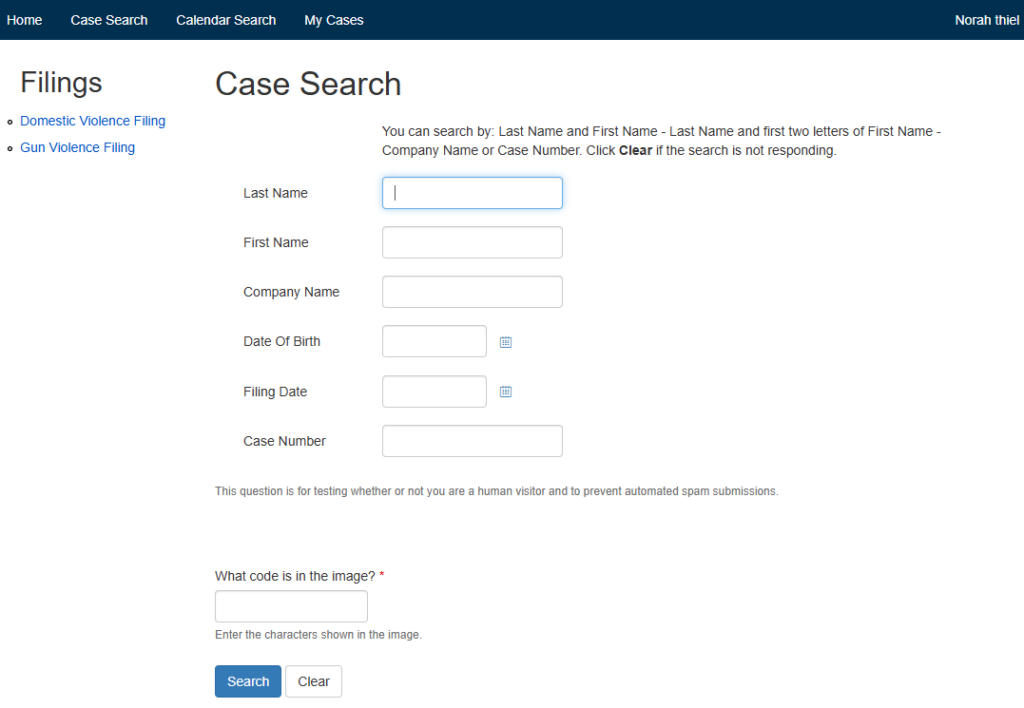
Search by Case Number
- Select “Search by Case Number.”
- Enter the complete case number exactly as assigned.
- Include all letters, numbers, and hyphens.
- Click Search or Submit.
Court Case Lookup by Name
- Select “Search by Party Name.”
- Enter the last name first, then the first name.
- Use correct spelling.
- Narrow results using a filing date range if available.
- Click Search.
Search by Filing Date Range
- Enter a start date and end date.
- Combine this filter with a party name for better results.
- Submit the search request.
Review the Search Results
After submitting your query:
- A results page will display matching cases.
- Click on the correct case number.
- Open the docket sheet to view the kern county court docket.
Interpret Docket Entries
Each docket entry includes:
- Entry date
- Description of action (e.g., Motion Filed, Hearing Held, Order Issued)
- Department or courtroom (if scheduled)
Printing or Saving Information
If the portal allows:
- Use the print option in your browser.
- Save the page as a PDF for records.
- Record the case number for future searches.
Types of Cases Available in the Kern County Court Docket
Kern county court docket records cover multiple case categories handled by the county trial court. These records document filings, court dates, rulings, and judgments in chronological order. Each division follows a structured docket format that creates a clear court timeline for public review. Below are the main case types available in the docket system and what users can expect to see in each.
Civil Division
The Civil Division handles disputes between private parties, companies, landlords, tenants, and other entities. A civil case docket focuses on lawsuits that seek money damages, property recovery, or court orders. These entries help users track procedural progress from the start of a lawsuit through resolution.
Civil docket entries typically include:
- Complaint filing date
- Proof of service on defendant
- Defendant’s answer or response
- Motion filings such as dismissal or summary judgment
- Case management conference dates
- Trial scheduling
- Final judgment entry
Criminal Division
The Criminal Division manages cases where the state files charges against a defendant. A criminal case docket tracks the prosecution process step by step. This division of kern county court docket records often includes charge codes and custody status updates.
Criminal docket entries usually show:
- Filing of criminal complaint
- Arrest record or warrant issuance
- Arraignment date
- Bail hearing outcome
- Plea entry
- Pretrial motion hearings
- Trial dates
- Sentencing orders
Family Law Division
Family Law cases involve domestic matters such as divorce, custody, child support, and protective orders. Family court records in the docket system show procedural updates without exposing private personal details. Some records may be limited to protect confidential information.
Family law docket entries often list:
- Divorce or custody petition filing
- Response from the opposing party
- Temporary court orders
- Mediation scheduling
- Custody hearings
- Child or spousal support modification requests
- Final judgment or settlement
Probate Division
The Probate Division handles estate administration, guardianships, and conservatorships. Probate case filings reflect court supervision of asset distribution and personal representatives. These entries document each legal step in estate management.
Probate docket entries commonly include:
- Petition to open estate
- Appointment of executor or administrator
- Inventory and appraisal submissions
- Notice to creditors
- Objections to estate actions
- Court approval of distribution
- Final discharge order
Small Claims Division
Small Claims cases resolve lower-value disputes quickly and efficiently. A small claims docket provides a brief yet structured record of case events, allowing parties to track filings, service, hearings, and outcomes. Most small claims matters conclude after a single court appearance, though some cases may include post-judgment updates. Typical entries include the plaintiff’s claim filing, proof of service confirmation, the scheduled hearing date, the judgment entry, and payment status updates.
Traffic Division
The Traffic Division processes moving violations and related infractions. A traffic case history appears within kern county court docket records for these matters. These entries allow drivers to review violation status and track resolution progress.
Traffic docket entries typically show:
- Citation filing date
- Court appearance schedule
- Fine assessment
- Payment confirmation
- Traffic school election
- License hold or compliance status
Docket Entries & Case Activity Log
Docket entries form the backbone of every court case record. Each entry appears in chronological order and creates a structured case activity log that shows how the matter progresses over time. By reviewing the filing timeline, users can quickly identify motions, hearings, rulings, and other case developments. A docket does not display full documents. Instead, it provides brief descriptions that summarize actions taken in court. Learning how to read these entries helps users interpret motion status, hearing results, and the overall court proceedings history.
How to Read Docket Abbreviations
Court systems use short codes and abbreviations to save space in docket entries. These shorthand terms appear next to motion filings, minute orders, and hearing updates. These abbreviations summarize events in a compact format. Reviewing multiple entries together gives a clearer picture of the case timeline.
Common examples include:
- Mtn – Motion
- Hrng – Hearing
- Min Ord – Minute Order
- Jdg – Judgment
- Cont. – Continued
- W/O Prej – Without Prejudice
Case Status Terms
Many docket entries include status updates that describe what happened during a court session. These terms reflect decisions made by the judge or procedural changes in the case. Understanding these terms helps users interpret hearing results accurately.
Here are key status terms explained:
- Disposed – The case has reached a final resolution. The court has entered judgment or dismissed the matter.
- Continued – The hearing or trial has been rescheduled to a later date. No final decision occurred at that time.
- Vacated – A previously scheduled hearing or order has been canceled. The court removed it from the calendar.
Filed vs. Entered: What’s the Difference?
Many people confuse “filed” with “entered.” The difference affects how the filing timeline appears in the case activity log. For example, a motion may be filed on one date, yet entered into the system the next business day. The docket entries will often list both dates. This distinction matters when tracking deadlines or motion status changes.
- Filed means a document was officially submitted to the court clerk.
- Entered means the clerk recorded the document or order into the court system.
Sample Docket Entry Table
Below is a simplified example of how docket entries may appear in a court proceedings history:
| Date | Entry Type | Description | Status |
|---|---|---|---|
| 01/05/2026 | Complaint Filed | Civil complaint submitted | Filed |
| 02/10/2026 | Motion Filed | Motion to Dismiss | Pending |
| 03/01/2026 | Hearing Held | Motion hearing conducted | Continued |
| 03/15/2026 | Minute Order | Court denies motion | Entered |
| 04/20/2026 | Judgment | Case resolved | Disposed |
Kern County Court Docket vs Full Court Records
Kern county court docket records provide a summarized timeline of case activity. They list procedural events in short descriptions without displaying complete documents. This makes them useful for quick status checks and hearing confirmations. Full court records, by contrast, contain the actual pleadings, exhibits, transcripts, and signed judicial orders. These detailed files form the official records of the case.
Docket = Summary Record
It does not typically include the full written motion or attached evidence. Users rely on the docket for high-level case tracking. A docket acts as a snapshot of the case timeline. It helps parties quickly identify procedural activity without reviewing the full court file. Docket entries summarize what happened, not the complete substance of filings. This makes dockets useful for monitoring status updates, hearing dates, and rulings at a glance.
- Case number
- Party names
- Filing dates
- Motion titles
- Hearing schedules
- Judgment entries
Full Court File = Detailed Documentation
A full court file contains complete legal documents submitted in the case. Obtaining these documents often requires a court file request through the clerk’s office. Some files may require fees for document retrieval. The court file provides the full context behind docket summaries and judicial decisions. Attorneys and litigants review the file to examine evidence, sworn statements, and signed orders. Access rules vary depending on case type, confidentiality laws, and record availability.
- Signed court orders
- Evidence exhibits
- Affidavits and declarations
- Trial transcripts
- Final judgments with official seals
When to Request Certified Copies
Certified copies are stamped and verified by the court as true and correct copies of official records. Courts provide certified copies for legal, financial, or government use. In these situations, a standard docket summary is not sufficient. Certified documents carry evidentiary value and are often required by agencies, lenders, or appellate courts. They confirm authenticity and ensure the document is legally recognized. Users must request certified copies directly from the clerk handling Kern County court docket records.
- Appealing a judgment
- Proving a divorce decree
- Recording a property judgment
- Submitting evidence to another court
How Often Are Kern County Dockets Updated?
Kern County dockets reflect ongoing court activity and are updated as new filings and rulings occur. These updates help users track filing status, monitor court calendar changes, and review real-time court updates through the online system. Most docket systems operate on daily docket updates, yet posting times depend on clerk processing and system workload. When a party files a document, the clerk must review and process it before it appears in the public system.
Update Frequency and Posting Timeline
Court filings are typically recorded on the same business day they are processed. Many entries appear within 24 hours, though timing may vary depending on the division and case volume. A motion marked as “filed” may not appear online until it is officially entered into the system. This short delay does not mean the filing was rejected.
Common factors affecting update timing include:
- Clerk review and data entry workload
- Court holidays or weekends
- High-volume filing periods
- Technical maintenance of the court database
Real-Time vs. Processed Updates
The term real-time court updates often refers to same-day electronic entries. Yet most public portals reflect processed updates rather than instant uploads. Users tracking urgent matters should verify important deadlines directly with the clerk’s office if an entry does not appear immediately.
For example:
- A document submitted at 4:30 PM may appear the next business morning.
- Court calendar changes made in the courtroom may post later that day.
- Hearing results are often entered after the clerk finalizes minute orders.
Public Access Rules & Restrictions
Public court records promote transparency, yet privacy laws limit what can appear online. Public record access California rules balance open records with the protection of confidential information. Not every case or document from the superior court is available for public viewing. Courts restrict access to certain records under state law. These records may not appear in online search results at all.
What Cannot Be Accessed
Certain categories remain restricted from online viewing. These limitations protect sensitive personal information and vulnerable parties. Courts apply confidentiality rules based on statute, judicial policy, and privacy protections. As a result, not all case types or documents appear in online docket systems. Users may see limited information or no information at all for protected matters.
Restricted records may include:
- Juvenile court records
- Adoption proceedings
- Mental health commitments
- Certain domestic violence matters
- Cases ordered sealed by a judge
Sealed Cases
A sealed case is removed from public visibility by court order. Once sealed, the docket entries and related documents are hidden from public systems. Only authorized parties, attorneys of record, or court personnel may review sealed cases. Sealing prevents disclosure of sensitive facts that could harm individuals, compromise privacy, or interfere with justice. In many instances, even the existence of filings may be restricted from general access.
Sealing may occur when:
- A judge grants a motion to seal
- A record qualifies for expungement
- Privacy rights outweigh public interest
Redacted Information and Privacy Laws
Redaction protects personal data while maintaining public transparency. Users conducting public record access California searches should expect limited personal details in online docket entries. These safeguards maintain trust in the court system and protect confidential records from misuse. Even in public cases, courts redact sensitive details. Redaction ensures that publicly accessible records do not expose information that could lead to identity theft or safety risks. The scope of redaction varies depending on case type and governing privacy laws.
Privacy laws require removal of:
- Social Security numbers
- Financial account numbers
- Driver’s license numbers
- Minor child information
Location & Court Information
Kern county court location details help visitors find the correct courthouse, contact the clerk’s office, and plan their visit efficiently. The main kern county courthouse address is located in Bakersfield, where the county’s primary court operations are conducted. The court operates under the authority of the Superior Court of California, County of Kern. Bakersfield serves as the central hub for many civil, criminal, family, probate, traffic, and small claims matters.
Main Kern County Courthouse Address
This downtown Bakersfield courthouse handles a wide range of case types. Court divisions may operate from additional branch locations, yet Truxtun Avenue serves as a key administrative site. The primary courthouse location is:
Superior Court of California, County of Kern
1415 Truxtun Avenue
Bakersfield, CA 93301
Office Hours
Clerk counters may close earlier than courtroom proceedings. Visitors should verify current hours on the official website before arrival. Standard public service hours are typically:
Monday – Friday: 8:00 AM to 3:00 PM
Closed on weekends and court holidays.
Phone Contact & Clerk’s Office Information
Staff at the public records counter can guide visitors on document retrieval and certified copy requests. Wait times may vary during high-volume periods.
Main Court Phone:
(661) 868-4934
The clerk’s office provides assistance with:
- Case number searches
- Court calendar information
- Filing procedures
- Public records inquiries
- Fee schedules
Frequently Asked Questions
These questions answers common questions about Kern County court docket searches in clear, structured language. It helps users find quick solutions while supporting strong search visibility. Each response explains key details about docket access, availability, and record limits. These answers reflect public court procedures and general California record policies.
How do I search Kern County court docket by name?
To search by name, visit the official website of the Superior Court of California, County of Kern and open the online case search portal. Select the “Search by Name” option. Enter the party’s last name first, followed by the first name. Use correct spelling for accurate results. If the system allows, narrow the results by adding a filing date range to filter older cases. After submitting the search, review the list of matching cases and select the correct case number. The docket page will display hearing dates, motion filings, orders, and case status updates in chronological order for public record review.
Are Kern County court dockets public records?
Most Kern County court dockets are considered public records under California law. Civil, criminal, small claims, probate, and traffic case summaries are generally available through the court’s online system. The docket displays procedural updates such as filings, hearings, and judgments. Certain case types remain restricted for privacy reasons. Juvenile court matters, adoption cases, mental health proceedings, and sealed cases may not appear online. Personal data such as Social Security numbers and financial account details are removed from public view. Public visibility depends on the case category and any court orders limiting disclosure. Users should expect partial information in sensitive matters.
How long does a case remain on the docket?
A case remains on the docket from the initial filing until final disposition. Even after the court enters judgment, the docket history often stays available for several years. Retention periods vary depending on the case type and court record management policies. Civil and criminal case summaries typically remain searchable after closure. Older cases may be archived, which can limit online visibility. Archived files may still be available through a clerk request. If a case does not appear online, it may have reached archival status or exceeded the court’s digital retention window. Record retention schedules determine how long docket data remains accessible.
Can I download or print docket entries?
Many court portals allow users to print docket summaries directly from their web browser. Users can select the print option and save the page as a PDF for recordkeeping. The docket itself usually provides summary information rather than full legal documents. To obtain complete pleadings or signed court orders, a formal records request may be required. Some document downloads may involve fees. Certified copies require an in-person or written request through the clerk’s office. The online system focuses on displaying the case timeline and procedural history rather than offering full file downloads in every matter.
What does it mean if my case is not showing online?
If a case does not appear in search results, several reasons may apply. The case may be recently filed and still pending clerk processing. Spelling errors or incorrect case numbers can prevent accurate matches. The matter may fall under restricted categories such as juvenile or sealed cases. Some older records may be archived and removed from online systems. Expunged or sealed matters will not display publicly. Users should double-check search details before contacting the clerk’s office. Court staff can confirm whether a case is public record eligible and provide guidance on next steps for locating the file.