Kern County Superior Court serves as the main county trial court for residents of Kern County, California. It operates within the California Courts and functions under the Judicial Branch of California, which oversees the statewide judicial system. As part of the state court system, this civil and criminal court handles felony, misdemeanor, civil, family, probate, and traffic matters. Judges hear evidence, issue rulings, and conduct trials at the local level. The court plays a central role in maintaining law and order across Kern County, including cities such as Bakersfield. It stands as the primary legal forum where disputes are resolved and justice is delivered daily.
Kern County Superior Court provides structured services that support the local judiciary and protect community rights. The superior court kern county California division manages criminal prosecutions, civil disputes, family law matters, probate proceedings, and traffic violations. It forms the foundation of the county trial court system, where most legal cases begin and reach resolution. Members of the public can review eligible court records through official case search systems or request files in person, subject to state privacy laws. Some case types remain restricted under California law, including juvenile and certain family records. Through these functions, the court maintains transparency, fairness, and accountability within the judicial branch California framework.
What Is the Superior Court of Kern County?
Superior Court Kern County California is the county’s main trial court where legal disputes, criminal cases, and family matters are heard and decided. It operates as part of the California Courts and serves as the foundation of the local county court system. The superior court kern county Court California belongs to California’s network of California trial courts, which exist in each of the state’s 58 counties. These trial courts hold trial jurisdiction, meaning they hear cases at the first level. Judges review evidence, listen to witnesses, apply state law, and issue rulings through formal legal proceedings. This process is known as case adjudication, where disputes are resolved based on facts and legal standards.
California Trial Courts and the Judicial Branch
California’s judicial structure includes three main levels:
| Court Level | Main Function |
|---|---|
| Superior Courts | Conduct trials and hear evidence |
| Courts of Appeal | Review trial court decisions |
| California Supreme Court | Highest authority on state law |
The Superior Court of Kern County functions at the trial level. It works under the Judicial Council of California, which oversees court administration statewide. As part of the judicial branch of California government, the court interprets and applies California statutes and constitutional law within Kern County. Each county has one superior court system. In Kern County, this court serves communities including Bakersfield and surrounding areas. It provides essential public judiciary services that support law enforcement, protect civil rights, and resolve private disputes.
Difference Between Superior Court and Appellate Courts
If a party disagrees with a decision made in superior court kern county California, they may file an appeal with the California Courts of Appeal. Appeals courts evaluate whether the law was applied correctly, rather than rehearing the entire case. Many people confuse trial courts with appellate courts. The difference lies in their function.
- Superior Court (Trial Court)
- Hears cases first
- Examines evidence and testimony
- Conducts jury and bench trials
- Issues judgments and sentences
- Appellate Courts
- Review decisions made by trial courts
- Do not conduct new trials
- Focus on legal errors rather than new evidence
Jurisdiction and Court Divisions
These matters are handled through specialized court divisions, each focused on specific case categories. This structure allows the county court system to manage a high volume of legal proceedings efficiently. The Superior Court of Kern County has broad jurisdiction over many types of cases. Its authority covers:
- Criminal cases – felonies and misdemeanors
- Civil disputes – contracts, property, injury claims
- Family law – divorce, custody, child support
- Probate matters – estates, guardianships
- Traffic and infractions
How to Search Kern County Superior Court Records
Kern County Superior Court case search allows users to locate case details through the official online portal. The system requires registration and login before the main search dashboard becomes available. Below is the complete process, including account registration and login instructions.
The official website is : https://www.kern.courts.ca.gov
The case search portal link is: https://portal.kern.courts.ca.gov
Visit the Official Website
- Open your browser.
- Enter: https://www.kern.courts.ca.gov
- Click on “Online Services.”
- Select “Case Information Search.”
After clicking Case Information Search:
- A terms and conditions page will appear.
- Click “Accept” and then “Enter.”
Register an Account
Before performing a kern county superior court case search, users must create an account.
On the portal page:
- Click “Register” (if you are a new user).
- Enter required details:
- Full Name
- Email Address
- Username
- Password
- Confirm your email if prompted.
- Complete the registration form.
Login to the Portal
- Enter your Username
- Enter your Password
- Click Login
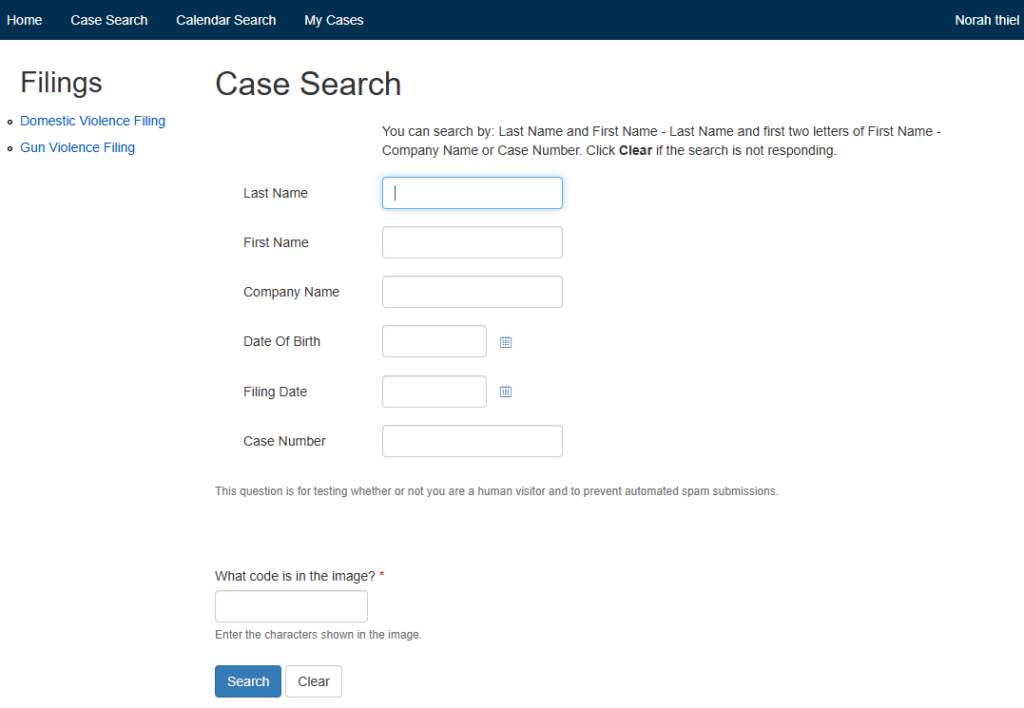
After login, the main search dashboard opens. This is where the full kern county court records search tools are located.
Top navigation options may include:
- Home
- Case Search
- Calendar Search
- My Cases
Click “Case Search” to begin.
Perform a Case Search
The search screen allows users to perform a public records lookup using several fields.
You may search by:
- Last Name
- First Name
- Company Name
- Date of Birth
- Filing Date
- Case Number
Best Search Method
- Use the Case Number for fastest and most accurate results.
After entering details:
- Click Search
- Review matching cases
- Click the case number to open docket details
Public vs Confidential Records
The court follows privacy rules under the Judicial Branch of California.
Records Commonly Displayed:
- Civil case summaries
- Criminal case status
- Traffic matters
- Probate filings
Records Restricted from Public View:
- Juvenile cases
- Adoption files
- Sealed matters
- Certain family law documents
Requesting Documents in Person
If full documents are not available online:
- Note the case number
- Visit the courthouse listed for the case
- Submit a records request form
- Pay copy or certification fees
Kern County Superior Court Structure & Judicial Administration
Judicial administration at Kern County Superior Court ensures that court operations run efficiently, fairly, and in compliance with California law. The court follows a structured leadership system that supports daily judicial operations, case management, and public service delivery. The Superior Court of California, County of Kern operates under a formal court governance model. This structure separates judicial decision-making from administrative oversight. Judges handle legal rulings, while administrative leaders manage staffing, budgeting, and court services. Together, they maintain order within the county court system and uphold standards set by the Judicial Council of California.
Court Leadership Structure
This framework supports court governance and ensures that judicial operations align with statewide rules and policies. Judicial administration at the court follows a clear chain of responsibility. Leadership roles focus on both legal authority and operational management.
Core Leadership Positions:
- Presiding Judge
- Assistant Presiding Judge
- Court Executive Officer (CEO)
- Bench Officers (Judges and Commissioners)
- Clerk and Administrative Managers
Role of the Presiding Judge
The Presiding Judge works closely with the Judicial Council of California to implement statewide judicial policies. This role ensures that local procedures align with California’s broader court system. The Presiding Judge serves as the chief judicial leader of the court. This judge is elected by fellow judges for a set term. The Presiding Judge focuses on leadership and direction rather than daily administrative management.
Key responsibilities include:
- Assigning judges to court divisions
- Supervising case distribution
- Overseeing courtroom procedures
- Representing the court in statewide meetings
- Supporting compliance framework standards
Role of the Court Executive Officer
The Court Executive Officer (CEO) manages the administrative side of judicial administration. The CEO is not a judge but serves as the court’s top administrative official. The CEO reports to the judges of the court and works in coordination with the Presiding Judge. This role ensures that resources support smooth judicial operations and public judiciary services.
Primary duties include:
- Managing the court’s annual budget
- Supervising non-judicial staff
- Overseeing facilities and security
- Implementing technology systems
- Ensuring policy compliance
Duties of Bench Officers
Bench officers include judges, commissioners, and referees. They conduct hearings, rule on motions, and oversee legal proceedings. Bench officers form the decision-making core of the court. They apply the law impartially during case adjudication. Their duties include:
- Presiding over trials
- Interpreting California statutes
- Issuing orders and judgments
- Managing courtroom conduct
- Protecting constitutional rights
Administrative Divisions and Oversight
Each division follows established procedures to support compliance framework requirements set by the Judicial Council of California. Through coordinated court governance, structured administrative oversight, and clearly defined leadership roles, judicial administration at Kern County Superior Court maintains efficiency, transparency, and accountability within California’s trial court system. The court operates through organized administrative divisions that handle:
- Criminal case processing
- Civil filings
- Family and probate services
- Jury administration
- Records management
Kern County Superior Court Divisions
Kern County Superior Court handles a wide range of legal matters through specialized court divisions. Each division focuses on specific case types, allowing the court to manage criminal cases, civil lawsuits, family disputes, and other legal proceedings efficiently. The Superior Court of California, County of Kern organizes its services into structured departments. This system improves scheduling, case adjudication, and courtroom management. Below is a breakdown of the major divisions within kern county superior court.
Criminal Division
The Criminal Division handles violations of California law prosecuted by the government. These cases involve defendants accused of breaking criminal statutes. Judges oversee trials where prosecutors present evidence and defense attorneys respond. Some cases resolve through plea agreements, while others proceed to jury trial. Criminal courtrooms operate under strict procedural rules. Bench officers protect constitutional rights and issue rulings based on evidence presented during hearings.
This division processes:
- Felony criminal cases
- Misdemeanor charges
- Arraignments and bail hearings
- Preliminary hearings
- Sentencing proceedings
Civil Division
The Civil Division manages disputes between private parties or businesses. These matters typically involve financial claims or legal responsibilities. Civil proceedings focus on liability and compensation rather than punishment. Judges determine whether a legal duty was violated and whether damages should be awarded. This division plays a major role in resolving commercial conflicts and private disagreements within Kern County.
Common civil lawsuits include:
- Personal injury claims
- Contract disputes
- Property damage cases
- Landlord-tenant disputes
- Small claims actions
Family Law Division
The Family Law Division addresses domestic matters that affect households and children. These cases often require sensitive handling and structured hearings. Judges prioritize the best interests of children during custody hearings. Court orders issued in this division carry legal authority and require compliance. Family law cases may involve mediation services before formal hearings. This helps reduce courtroom conflict and promotes resolution.
The division handles:
- Divorce and legal separation
- Custody hearings
- Child support determinations
- Spousal support orders
- Domestic violence restraining orders
Probate Division
The Probate Division supervises estate administration and related matters after a person passes away or becomes incapacitated. Estate administration involves validating wills, appointing executors, and distributing assets to beneficiaries. Judges review filings to confirm legal compliance. Probate proceedings protect heirs, minors, and vulnerable adults through court supervision.
This division oversees:
- Wills and estate distribution
- Probate petitions
- Guardianships
- Conservatorships
- Trust disputes
Traffic Division
The Traffic Division handles non-criminal vehicle violations and certain misdemeanor driving offenses. Drivers may resolve minor matters by paying fines or appearing in court. Some traffic cases allow remote or online resolution options. Traffic court reduces congestion in criminal courtrooms by processing high-volume vehicle-related cases separately. Judges in this division focus on efficient case resolution while ensuring compliance with traffic laws.
Cases typically involve:
- Traffic citations
- Speeding violations
- Red-light infractions
- Driving without insurance
- Requests for traffic school
Juvenile Division
The Juvenile Division focuses on cases involving minors. These proceedings differ from adult court in structure and confidentiality. Juvenile dependency cases address allegations of abuse or neglect. Judges review reports from child protective services and determine safe placement for minors. Records in juvenile court remain restricted to protect privacy. The court emphasizes rehabilitation and the best interests of the child over punitive outcomes.
The division manages:
- Juvenile delinquency cases
- Juvenile dependency matters
- Child welfare hearings
- Foster care placement reviews
Filing a Case in Kern County Court
File a case kern county superior court by submitting the correct legal forms, paying required filing fees, and following the official court submission process. The court accepts civil filings from the public and criminal complaints from prosecutors through structured procedures. The Superior Court of California, County of Kern processes new cases through the court clerk office and approved electronic systems. Each case type follows California procedural law. Proper documentation and accurate information help prevent delays or rejected filings.
Civil Filing Process
To file a civil case, a plaintiff must prepare a complaint that explains the legal claim. This document states the facts, identifies the defendant, and describes the requested relief. After submission, the clerk reviews the paperwork for compliance. If accepted, the court assigns a case number and schedules future proceedings. The plaintiff must complete proof of service to confirm the defendant received notice.
The basic steps include:
- Complete the required Judicial Council legal forms.
- Attach supporting documents if necessary.
- Submit the documents to the court clerk office or through electronic filing.
- Pay the required filing fee.
- Serve the defendant with a copy of the filed documents.
Criminal Complaint Process
Private parties do not directly file criminal charges. Law enforcement agencies investigate alleged crimes and prepare reports. These reports are reviewed by the district attorney. If sufficient evidence exists, the district attorney files a criminal complaint with kern county superior court. The defendant then appears at an arraignment hearing. At this stage, the court advises the defendant of charges and rights.
The criminal complaint process generally includes:
- Police investigation
- Review by prosecution
- Filing of formal charges
- Arraignment and bail determination
Required Documents
Family law, probate, or guardianship cases require additional specialized forms. Forms must be completed accurately and signed where required. Using outdated forms may result in rejection. Approved legal forms are available through California Judicial Council resources and the court’s official website. The documents required to file a case kern county superior court depend on the case type. Common civil filing documents include:
- Complaint or petition
- Civil case cover sheet
- Summons form
- Proof of service
- Supporting declarations
E-Filing Availability
Certain case types may require mandatory electronic filing through approved vendors. Criminal complaints filed by prosecutors use separate secured systems. By following the proper procedures and submitting complete documents, litigants can successfully file a case kern county superior court and begin formal legal proceedings within California’s county court system. Electronic filing is available for many civil, family, and probate matters. E-filing allows users to upload documents online without visiting the courthouse.
Benefits of electronic filing include:
- Faster processing confirmation
- Secure document submission
- Online fee payment
- Reduced paper handling
Fees, Payments & Traffic Citations
Kern county superior court payment options help individuals resolve traffic citations, court fines, and official fees through multiple methods. Traffic ticket payment and fine settlement must be made on or before the date listed on the citation or courtesy notice to avoid penalties. The court provides online, mail-in, and in-person choices for citation payment and other financial obligations.
The Superior Court of California, County of Kern handles traffic payments through its Traffic Court divisions and partner online systems. Traffic citation fines may vary based on the violation in question, including base fines plus state-mandated assessments and fees. If fines are not paid by the due date, a civil assessment penalty of up to $100 may be added to the total amount owed.
Traffic Ticket Payment
The court’s online system allows users to enter their citation or case number and complete payment. A convenience fee may apply when paying by credit or debit card. When responding to a traffic citation, drivers typically have these options:
- Pay the fine in full before the due date
- Request an extension or payment plan (through online tools or clerk review)
- Contest the citation by indicating a not-guilty plea in writing or in person
- Request traffic school if eligible (traffic school may remove points but requires additional administrative fees)
Fine Payment Methods
Below is a summary of common ways to complete a kern county superior court payment:
Online Payment
• Use the court’s ePayIt online portal for citation and fine payments
• Enter citation or case number to locate the case
• Accepts credit/debit cards (service fees may apply)
Mail Payment
• Send check or money order
• Include citation number and contact information
• Do not send cash by mail
In-Person Payment
• Visit the Traffic Court clerk window
• Pay by cash, check, money order, or debit/credit card
Drop-Box Payment
• Some locations provide secure drop boxes for payments and correspondence available 24/7
Fee Schedule
Court fines and fees vary depending on the specific citation or case type. Charges may include base fines, penalty assessments, and administrative fees. Below is an example fee table based on generally applicable traffic citation categories in California:
| Type of Fee | Estimated Amount |
|---|---|
| Base Traffic Infraction Fine | $35–$100+ |
| Civil Assessment Penalty (late) | Up to $100 |
| Administrative Fee | Varies |
| Traffic School Administrative Fee | Varies |
Online Payment Methods
Users select the citation or case to pay and enter credit/debit information to complete the transaction. The court supports citation and fine payments through its official online portal: https://kern.epay-it.com – This system lets users:
- Pay and close traffic or non-traffic citations
- Sign up and pay for traffic school
- Make payments on established installment plans
- Pay various outstanding court-ordered fines and fees
Judges & Bench Officers of Kern County Superior Court
Kern County Superior Court judges serve as the primary decision-makers in criminal, civil, family, probate, traffic, and juvenile cases. These judges oversee trials, interpret California law, and issue legally binding rulings within the county court system. The Superior Court of California, County of Kern is staffed by elected judges and appointed bench officers who manage courtroom proceedings across Kern County. Their role supports fairness, due process, and consistent application of state law.
Role of Judges in Kern County
Kern county superior court judges preside over legal proceedings from arraignment to final judgment. They ensure court rules are followed and protect constitutional rights during hearings and trials. Judges maintain courtroom order and provide written rulings when required. Their decisions form part of the official court record. Core judicial responsibilities include:
- Conducting jury and bench trials
- Ruling on motions and objections
- Issuing sentencing orders in criminal cases
- Deciding liability in civil disputes
- Approving settlements and court agreements
Appointment and Election Process
Superior court judges in California are either elected by county voters or appointed by the Governor of California when a vacancy occurs. Candidates must meet eligibility standards, including active membership in the State Bar of California for a minimum period. This system balances public accountability with professional qualification standards. The process generally works as follows:
- A sitting judge retires or vacates office
- The Governor appoints a qualified attorney or judicial officer
- The appointed judge may later stand for election
- Judges serve six-year terms
Responsibilities of Bench Officers
Through structured leadership and courtroom oversight, Kern County Superior Court judges and bench officers maintain fair case adjudication across the county trial court system, while bench officers support daily judicial operations across all divisions. Their responsibilities include presiding over hearings, reviewing legal filings, issuing temporary and final orders, managing calendars and scheduling, and ensuring procedural compliance.
Kern County Jury Duty
Kern county jury duty requires eligible residents to respond to a jury summons and remain available for potential courtroom service. Jury service supports fair trials by allowing community members to decide facts in civil and criminal cases. Courts depend on jurors to uphold justice at the local level. The Superior Court of California, County of Kern manages jury operations through a structured juror portal system. Every summoned resident must follow the instructions printed on the notice. Timely response helps the court schedule trials without delay.
Responding to a Jury Summons
When a juror receives a summons, immediate action is required. The notice includes a juror ID number and reporting timeframe. Ignoring the summons may result in penalties or rescheduling requirements. The court uses an online juror portal to manage confirmations and deferrals. This system helps organize jury pools efficiently. Jurors should complete the response process as soon as possible.
Steps typically include:
- Visit the official juror portal on the court website.
- Enter the juror ID number and requested personal details.
- Confirm availability or request a new date.
- Review updated reporting instructions.
Reporting Instructions
Before appearing at the courthouse, jurors must verify whether they need to report. The court may place jurors on standby depending on case scheduling. Checking status prevents unnecessary courthouse visits. Reporting information is updated through the online system or phone instructions. Jurors should review details the evening before their assigned date. This step supports organized jury service management.
Reporting instructions usually provide:
- Courthouse location
- Reporting time
- Assigned department
- Estimated service duration
Juror Pay
California law sets compensation standards for jury service. Payment begins after the first day of attendance. Mileage reimbursement helps offset travel costs. Juror compensation encourages civic participation while maintaining fairness. Employers may provide additional paid leave depending on company policy. Jurors should check workplace rules in advance. Typical compensation includes:
- $15 per day starting on the second day
- One-way mileage reimbursement at the approved state rate
Excusal and Deferral Requests
The court recognizes that some residents face hardships that prevent service. Valid excusal requests require explanation and, in many cases, supporting documents. The court reviews each request carefully. Deferrals allow jurors to postpone service to a later date. This helps maintain flexibility within the jury service framework. Requests must follow the instructions printed on the summons.
Common excusal grounds include:
- Medical hardship
- Financial hardship
- Caregiver responsibilities
- Prior recent jury service
Public Access Kern County Superior Court
Public access kern county superior court reflects California’s commitment to open court principles and government transparency. Courts operate in a manner that allows public observation and review of many legal proceedings. Transparency strengthens confidence in the judicial process. The court follows policies established by the Judicial Council of California. These policies support public oversight while protecting confidential information. Court accountability remains a central part of judicial operations.
Public Records Policy
Court records form part of the public court docket and documents system, subject to statutory privacy protections. Most civil and criminal case summaries are available for review. Record availability depends on California confidentiality laws. The court balances transparency with privacy safeguards. Some case types remain restricted to protect minors or sensitive personal information. The clerk’s office manages document release procedures.
Records commonly available include:
- Civil case dockets
- Criminal case status summaries
- Probate filings
- Court calendars
Court Transparency and Media Access
Open court principles allow members of the public and media to attend most hearings. Courtrooms remain open unless a statute permits closure. This practice promotes government transparency. Media organizations may request permission for courtroom coverage under California Rules of Court. Approval depends on judicial discretion and case sensitivity. Recording devices require prior authorization.
Kern County Superior Court Locations
Kern county superior court locations serve residents across multiple cities to ensure accessible judicial services throughout the county. From major metropolitan courthouses to regional justice facilities, each location handles specific case types including civil, criminal, traffic, family, and probate matters. Knowing the correct courthouse helps avoid delays and ensures proper filing procedures.
Bakersfield Courthouse Locations
Bakersfield serves as the primary judicial hub for Kern County. Multiple court facilities are located within the city, handling a broad range of case types. Most administrative and central court operations are based here.
The main courthouse in Bakersfield is:
- Metropolitan Division (Justice Building)
1215 Truxtun Avenue, Bakersfield, CA
Handles criminal, traffic, and limited civil matters.
Ridgecrest Branch
The Ridgecrest branch provides court access to residents in eastern Kern County. This location reduces the need to travel to Bakersfield for routine matters. It handles traffic, criminal, and limited civil cases.
- Ridgecrest Branch Court
132 East Coso Avenue, Ridgecrest, CA
Delano Branch
The Delano courthouse supports residents in northern Kern County. It handles local criminal, traffic, and certain civil proceedings. This branch ensures broader geographic access to judicial services.
- Delano Branch Court
1122 Jefferson Street, Delano, CA
Lamont Branch
The Lamont branch serves southeastern Kern County communities. It processes misdemeanor, traffic, and limited civil cases. The location helps reduce travel burdens for local residents.
- Lamont Branch Court
12022 Main Street, Lamont, CA
Mojave Branch
The Mojave branch provides judicial services to residents in the eastern desert region of Kern County. It handles criminal and traffic cases primarily. Civil matters may be limited depending on jurisdiction.
- Mojave Branch Court
1773 State Highway 58, Mojave, CA
Shafter Branch
The Shafter branch court serves communities in northwestern Kern County. It handles traffic, misdemeanor, and limited civil matters. The facility provides local access for residents outside Bakersfield.
- Shafter Branch Court
325 Central Valley Highway, Shafter, CA
Frequently Asked Questions
Kern County Superior Court handles civil, criminal, family, probate, and traffic matters across multiple courthouse locations in California. Many residents search online for clear answers about case lookup, payments, filings, and contact procedures. This FAQ section is structured to provide direct, accurate responses in a simple format. The information below reflects general court procedures and public access guidelines.
How do I search a case?
To search a case with Kern County Superior Court, visit the official court website and use the online case search system. Most civil, criminal, family, probate, and traffic case summaries can be searched using a case number or party name. Accurate spelling is important when entering names to avoid missing results. Some case types may require selecting the correct division before searching. Confidential, sealed, or juvenile cases are not publicly available online. If you cannot locate your case, contact the clerk’s office for assistance or visit the courthouse where the matter was filed. Always confirm the case status before appearing in court.
Where is the main courthouse?
The main courthouse for Kern County Superior Court is located in Bakersfield, California. The primary Metropolitan Division is at 1215 Truxtun Avenue and handles criminal, traffic, and certain limited civil matters. Bakersfield serves as the central administrative hub for county court operations. However, different case types such as family law, probate, or juvenile matters may be assigned to separate buildings within the city. It is important to check your hearing notice carefully to confirm the correct department and courtroom. Arriving at the wrong courthouse can delay your case. Always verify the address and reporting time through the official court website before attending.
How do I pay a ticket?
Traffic tickets issued in Kern County can usually be paid online, by mail, or in person at the assigned courthouse. Online payment is the fastest and most convenient option through the court’s traffic portal. You will typically need your citation number and date of birth to locate the fine. Payment must be made before the due date listed on the citation to avoid additional penalties. If you plan to contest the ticket, do not pay it, as payment may be treated as a plea. Instead, request a court hearing before the deadline. Late responses can result in added fees or license restrictions.
How do I contact the clerk?
You can contact the clerk of Kern County Superior Court by phone, in person, or through the contact information listed on the official website. Each division, such as civil, criminal, family, or traffic, may have separate contact numbers. The clerk’s office can provide procedural information, confirm hearing dates, explain filing requirements, and process payments. However, clerks cannot give legal advice or recommend legal strategies. Office hours are generally Monday through Friday, excluding court holidays. Before calling, have your case number ready to help staff locate your file quickly. For faster service, confirm which courthouse is handling your case.
How do I file for divorce?
To file for divorce in Kern County Superior Court, you must submit a Petition for Dissolution of Marriage with the Family Law Division. The filing party completes required California Judicial Council forms and pays the applicable filing fee unless a fee waiver is approved. After filing, you must legally serve your spouse with copies of the documents and file proof of service with the court. Both parties must exchange financial disclosures before the case can proceed to settlement or trial. California law requires a minimum six-month waiting period before a divorce becomes final. Complex cases involving property, custody, or support may require additional hearings.